
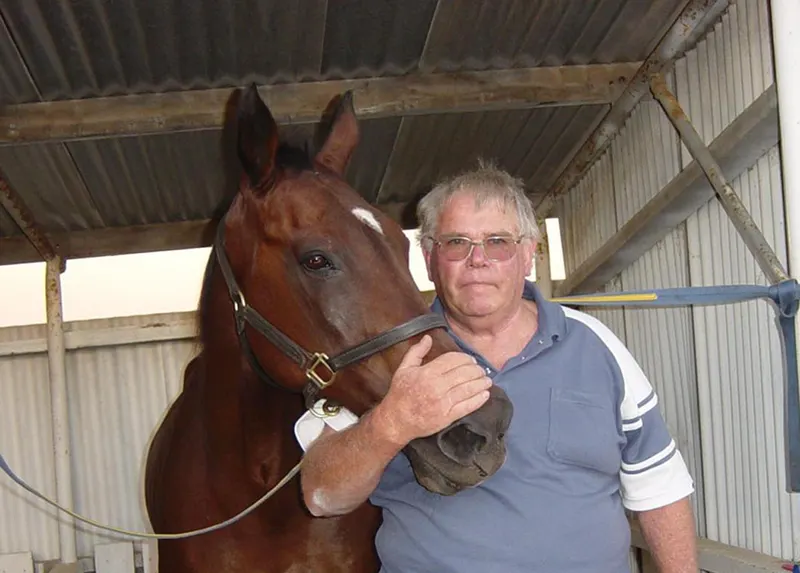
Passing of Inter Dominion winning horseman
GENIAL horseman Bill Horn sadly passed away last night.
Horn took up training as a challenge following a disagreement with another trainer over the preparation of one of his horses, Prince Brino.
When he criticised the trainer after a defeat one day he was told “try to do better yourself”, so he did, training Prince Brino for a first-up win.
Following that disagreement, Horn decided to take an active part in trotting, just as `a hobby’ as a sideline to his butcher shop in the Perth suburb of Hilton, which carried the title `Bill _ the better butcher’.
Only a `battler’, like a lot of others in the sport who keep the game going, Horn had a dream of one day owning and training a champion.
Horn and his wife, Norma, who ran the business when the trainer was tending to his horses, started their assault on the sport by travelling to far away country towns to try and `pick up a race’ or two with Prince Brino.
Horn quickly displayed his talents when Prince Brino landed a substantial plunge at York. Backed in from 25/1 to even money, Prince Brino provided the trainer with his first winner. That early success enabled Horn to settle into the sport.
Soon after he leased a nine-year-old pacer named Miner Karamea from Gordon Cox, little realising the association between the pair would grow, and that some 15 years later, he and Cox, and their wives, would race the legendary Village Kid.
Miner Karamea had not won for several years when Horn took over his training. His technique of swimming his horses at the beach seemed to revitalise the pacer, who went on to win in the city, as well as running many minor placings.
When Miner Karamea completed his first season of racing for Horn he had amassed more than $30,000.
Later Gordon Cox leased a share of Black Irish to Bill and Norma Horn.
Black Irish originally raced in Tasmania for Terry Peck, winning five of his 15 starts, with eight minor placings, before going to Perth where he was reined to a further 16 wins by Kevin Batt. Black Irish later suffered leg problems, which were ultimately treated by Dr Tom Rieusset.
Entering Horn’s stables as a nine-year-old, Black Irish provided Horn with his first major training success when he won the 1982 Fremantle Members’ Flying Mile in 1:57.9.
Black Irish retired with earnings of $272,366, with his 94 starts producing 38 wins, 13 seconds and 10 thirds.
Horn prepared him to win over $160,000 in two seasons including the 1982 Australian Pacing Championship at Gloucester Park, plus two heats of the 1984 Inter Dominion in Adelaide.
Following the success with Miner Karamea and Black Irish, Cox entrusted the training of his latest pacer, Village Kid, to Horn.
Bred in New Zealand, Village Kid was purchased from Patumahoe market gardener and amateur trainer Brian Notman, who earlier had bought the horse as a weanling for $500 from Auckland studmaster, Irvin Behrns.
Deciding to sell his standardbred stock before changing to thoroughbreds, Behrns sold six horses to Notman.
“I agreed to deliver them and realised there was room for one more on the float. I showed Brian a Gramatan weanling, said he could have it for $500 to fill the float, and the deal was done.” Behrns said.
That Gramatan weanling was Village Kid, which is listed in Volume 24 of the New Zealand Trotting Stud Book as being dead.
Totara Valley, the dam of Village Kid, is listed in that volume as having left only four live foals up to 1981. Her 1980 Gramatan colt foal is registered as dead. Village Kid, however, is the 1980 foal.
The mistake arose when Notman sent a list of horses, who had died, and also one that had no papers to the NZ Trotting Conference. Village Kid was the horse that had no papers.
At the same time it was mistakenly noted he had `died’. The error was picked up by Notman some months later, but it was too late to correct the mistake in the Stud Book as it had already gone to print.
Unraced as a two-year-old, Village Kid had nine starts in New Zealand at three during 1983-84 for three wins and one second, earning $7195.
Offered for sale at $2000 before he raced, there were no takers. Later he was rejected for $8000.
By the time Gordon Cox took an interest in Village Kid, the price had climbed to a reported $40,000.
The gelding first came to the attention of Cox when Perth horseman, Dudley `Boof’ Anderson returned home after a New Zealand holiday.
Anderson, who won the 1977 Miracle Mile with Royal Force, trialled Village Kid in New Zealand.
On his arrival back in Perth, Anderson, armed with a couple of videotapes showing Village Kid winning, suggested the gelding could be bought for the right price and recommended him to Cox.
Village Kid was a bad knee-knocker and had bad feet problems. Although he had won three of his nine New Zealand starts, Anderson told Cox the horse could be “anything” once the problems were sorted out.
Reaching Horn’s stables in late July, 1984, Village Kid did not take long to show what he could do, after Anderson had corrected his shoeing problems.
The gelding raced 27 times as a four-year-old during 1984-85, for 17 wins, seven seconds and two thirds. He picked up $243,237 to finish second behind Preux Chevalier ($448,678) as the top stake earner in Australia.
From a humble WA debut – winning a minor country race at Pinjarra in October, 1984 – Village Kid thrilled Australian harness racing fans for almost a decade and became WA’s first million dollar horse, galloper or pacer, Australia’s first two million dollar earner, and the world’s richest pacing gelding.
Village Kid won 13 Group Ones, including the 1986 Inter Dominion and two Miracle Miles.
His earnings of $2,117,870, the result of 93 wins, 24 seconds and 12 thirds from 160 starts, made him the 12th richest pacer in the world.
Horn continued to have success with his team after Village Kid’s retirement, but none came close to the champion.
National Trotguide extends its condolences to Horn’s family and friends.
- BOB CAIN